Editor's Note: This article was originally published in January 2016 and has been updated to reflect changes in technology, organizational practice, and current thinking. Most recent update: July 31, 2026.
Understanding the Difference
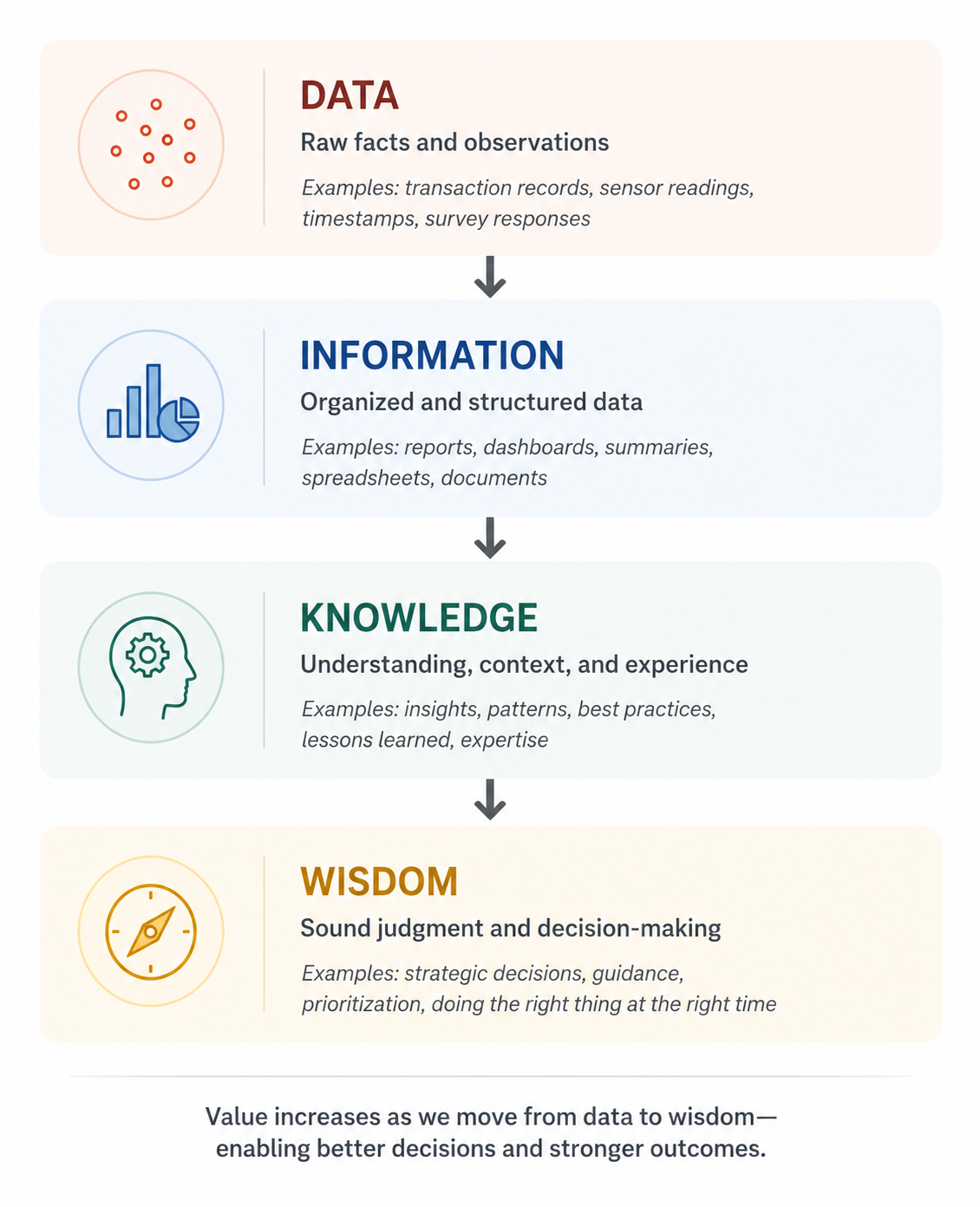
Data, information, knowledge, and wisdom represent different stages in how organizations understand and use what they know. Data consists of individual facts or observations. Information gives that data structure and context. Knowledge combines information with experience, interpretation, and understanding. Wisdom applies that knowledge to make sound judgments and decisions.
The distinctions are important. Organizations may have large volumes of data and information without having the knowledge – or the judgment – needed to act on them effectively.
Data
Data consists of individual facts, observations, or measurements without interpretation or context. A spreadsheet of sales figures, a list of customer records, or a meeting transcript are all examples of data.
By itself, data has limited meaning. Its value depends on how it is organized, interpreted, and applied.
Information
Information is data that has been organized, structured, or presented in a way that provides meaning. Reports, dashboards, summaries, and documents all transform raw data into information that people can understand.
Information answers questions like what happened, when, and where.
Knowledge
Knowledge goes a step further. It combines information with experience, judgment, context, and understanding.
Knowledge enables people to recognize patterns, solve problems, make decisions, and adapt information to new situations. Unlike data or information, knowledge exists partly within people and partly within the documents, processes, and systems they create.
This is why two people can review the same information and reach different conclusions based on their experience.
Wisdom
Wisdom is the ability to apply knowledge thoughtfully in context.
It reflects sound judgment, an understanding of trade-offs, and the ability to make decisions that consider both immediate outcomes and long-term consequences.
Organizations often invest heavily in collecting data and producing information. The greatest value, however, comes from developing the knowledge and judgment that allow leaders to use that information effectively.
Two Types of Knowledge
Explicit Knowledge
Explicit knowledge is knowledge that has been documented, organized, and shared in a form that others can access. Policies, procedures, project documentation, research reports, meeting notes, and training materials are all examples of explicit knowledge.
Because explicit knowledge can be stored and shared, it forms much of an organization's institutional memory. It is also the type of knowledge that enterprise search systems, Microsoft 365, and AI tools are generally able to access and work with.
Tacit Knowledge
Tacit knowledge exists primarily in people's experience. It includes judgment, intuition, practical know-how, relationships, and the lessons people have learned over time.
This knowledge is often difficult to document completely because people may not even realize what they know until they need to apply it.
Organizations lose tacit knowledge every time experienced employees retire, change roles, or leave unless deliberate efforts are made to capture and transfer it.
Why the Distinction Matters for Organizations
Organizations often invest heavily in collecting more data and producing more reports. Yet better decisions rarely come from having more information alone.
The real competitive advantage comes from developing organizational knowledge – capturing what people know, making expertise easier to find, and creating systems that help employees apply that knowledge consistently.
Understanding the difference between data, information, knowledge, and wisdom helps leaders ask better questions:
- Are we collecting data we don't actually use?
- Do employees have access to the information they need?
- Are we preserving organizational knowledge when people leave?
- Are we creating the conditions for better decisions, not simply more information?
Why This Matters for AI
Artificial intelligence has renewed interest in organizational knowledge, but AI changes surprisingly little about the underlying concepts.
AI systems can analyze large amounts of data, summarize information, and help people retrieve documented knowledge. They are far less effective at replacing the experience, judgment, context, and organizational understanding that people develop over years of work.
Organizations with well-organized information, clear governance, and accessible explicit knowledge are often better positioned to benefit from AI than organizations with larger volumes of poorly managed information.
In many ways, AI has made knowledge management more important – not less.
From Knowledge to Organizational Capacity
Successful organizations do more than collect information. They create systems that allow knowledge to be shared, improved, and applied over time.
That includes:
- documenting important processes
- preserving institutional knowledge
- establishing clear information governance
- making expertise easier to discover
- creating cultures that encourage learning and knowledge sharing
These capabilities improve onboarding, strengthen decision-making, reduce operational risk, and help organizations adapt as they grow.
Final Thoughts
Technology continues to evolve, but the distinction between data, information, knowledge, and wisdom remains remarkably consistent. Organizations that understand these concepts are better equipped to organize what they know, make thoughtful decisions, and adopt new technologies—including AI—with greater confidence.
Building those organizational capabilities is ultimately what knowledge management is all about.
Continue Reading
- What is Knowledge Management? An Executive Guide – Learn why organizational knowledge is one of an organization's most valuable strategic assets.
- Information & Data Governance Executive Guide: Explore how governance helps organizations improve decision-making and reduce risk.
- The Best First Enterprise AI Projects Are Often the Boring Ones: Discover why practical improvements like meeting notes and enterprise search often create the biggest early AI wins.
- Architecting for AI: Why the Future Starts with Decisions You're Making Today: See why strong information & knowledge practices are essential for successful AI adoption.
- Knowledge Management Consulting Services: Learn how FireOak helps organizations strengthen knowledge sharing, governance, and long-term organizational capability.